Dawn, Drizzle and a Fiver: The Unwritten Rules of the Great British Car Boot Sale
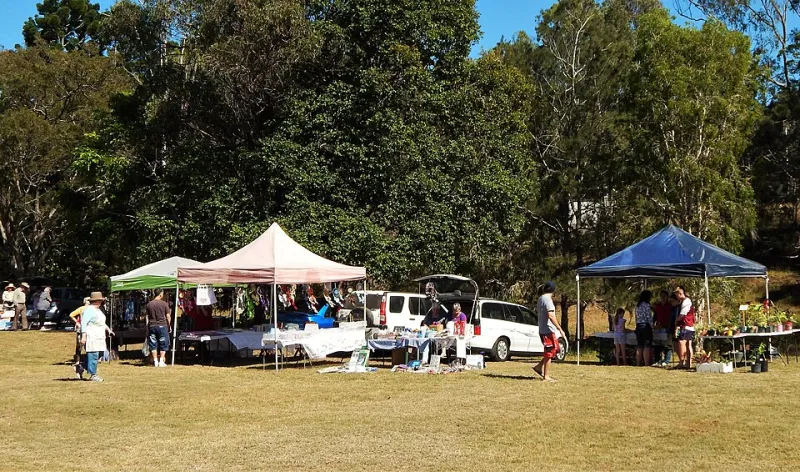
Photo: RegionalQueenslander, CC BY-SA 4.0, via Wikimedia Commons
At 6.40 on a Sunday morning, a field off the A41 is generating more commerce than most high streets manage by lunchtime. Headlights sweep across wet grass. A tailgate drops with a clatter somewhere in the gloom. A man in a fleece is already asking whether the box of records is 'all one price'.
This is the great British car boot sale: part jumble sale, part amateur dramatics, part free economics lesson delivered through a folding table and a tarpaulin.
The dawn shift
Long before the buyers arrive, there are the sellers. They queue in the dark with a flask wedged in the cup holder, a boot so full the parcel shelf has been left at home, and a quiet conviction that today is the day the Wedgwood goes. Pitch fees tend to hover between a tenner and twenty quid depending on the field, the county and whether the organisers have gone digital.
Then comes the ritual laying out. Clothes are folded and arranged by size on a groundsheet. Books go spine up, which is a rookie error because nobody can read them from a standing position and everyone will nudge them into a fan within twenty minutes. Somebody's grandmother's dinner service is stacked with a hand-written sign reading 'complete, no offers, please'.
The etiquette is entirely unwritten
Nobody issues you a rulebook at the gate, yet everybody seems to know the code.
- Cash and coins. Cards are creeping in at the bigger sites, but a seller who has to go and find the card reader will remember your face forever, and not warmly.
- Ask before you dismantle. Opening a sealed box, untying a bundle of tools or testing a lawnmower is usually fine — but ask first, because a stall is a small kingdom and the seller is its monarch.
- Do not hover during the unload. The vultures who circle a half-empty boot before the table is up are the closest thing the boot sale has to a predator.
- Haggle properly. 'What's your best on that?' is the correct opening. Offering half and walking away is not haggling, it is a threat.
- If you pick it up, you have bought it. This is the single most observed law in the field, and the source of most of the day's quiet grudges.
Haggling, the national sport nobody televises
The real entertainment is the negotiation. A cast-iron pan marked at eight quid, a buyer opening at four, the seller doing the small theatrical sigh that suggests their own children may go hungry, and the eventual handshake at six. Everyone involved knows it is a performance. It is also, somehow, the most honest conversation you will have all week.
There is a particular genre of seller who insists everything is 'for the charity, like', which may be true and may be a negotiating strategy of considerable sophistication.
The characters you will meet
The man with forty identical socket sets, arranged in a grid, who will not sell them individually. The woman with a table of soft toys and a story about each one. The house-clearance bloke whose stock suggests a garage has recently been emptied wholesale, including the shelving. The child running a sticky lemonade stand at a loss. The guitar seller who says 'it's a Fender, like' — it is not a Fender, and he knows it is not a Fender.
Then there is the serious end of the field: the dealers with rucksacks and head torches, moving fast, buying quietly, likely to have three items gone before the kettle's boiled.
Regional flavours differ too. Northern sites tend to be bigger, muddier and better catered, with a bacon van doing a proper trade by eight. The southern counties offer more polite haggling and more picnic rugs. In Scotland the weather is a participant, not a backdrop, and everyone is better dressed for it.
The mid-morning shift matters most. That is when the serious browsers arrive — the ordinary families, the students furnishing a flat, the person after a bike for a nine-year-old who has grown out of the last one.
The legend of the lucky find
Every sale has its folklore. Depending on who you believe, a two-pound picture frame has concealed a watercolour worth five figures more than once; a first-edition children's book has turned up in a box of paperbacks; a dusty little bowl has been carried to a saleroom in a carrier bag and done rather nicely. Take each tale with a pinch of salt. Boot-sale finds are the British equivalent of the fisherman's story, and nobody wants the ending to be 'it was a reproduction'.
But the possibility is the point. The whole field runs on the possibility that the next trestle table has something extraordinary on it, priced at £2 and labelled 'vase'.
Why it still works
In an age of infinite scrolling, nothing on your phone can surprise you the way a box of mismatched cutlery can. The boot sale is a surprise engine. It smells of wet grass and diesel. It costs almost nothing to attend. And in a country where a coffee and a sandwich can set you back fifteen pounds, the promise of furnishing an entire kitchen for the same money has a stubborn appeal.
The reuse angle helps too. What was once faintly embarrassing — economy, make-do, other people's cast-offs — now reads as sensible.
A beginner's field guide
Go early for the quality, late for the bargains, and pick a dry weekend if you possibly can. Take cash in small notes. Bring a bag for life and a boot that is emptier than you think. Be pleasant, be quick, and do not block the aisle while you ring someone to ask whether they need a hedge trimmer.
And buy the thing. You will regret the thing you put back far longer than you will regret the fiver you spent.