Shopfront Soap Opera: The Unscripted Genius of Britain’s Charity Shop Windows
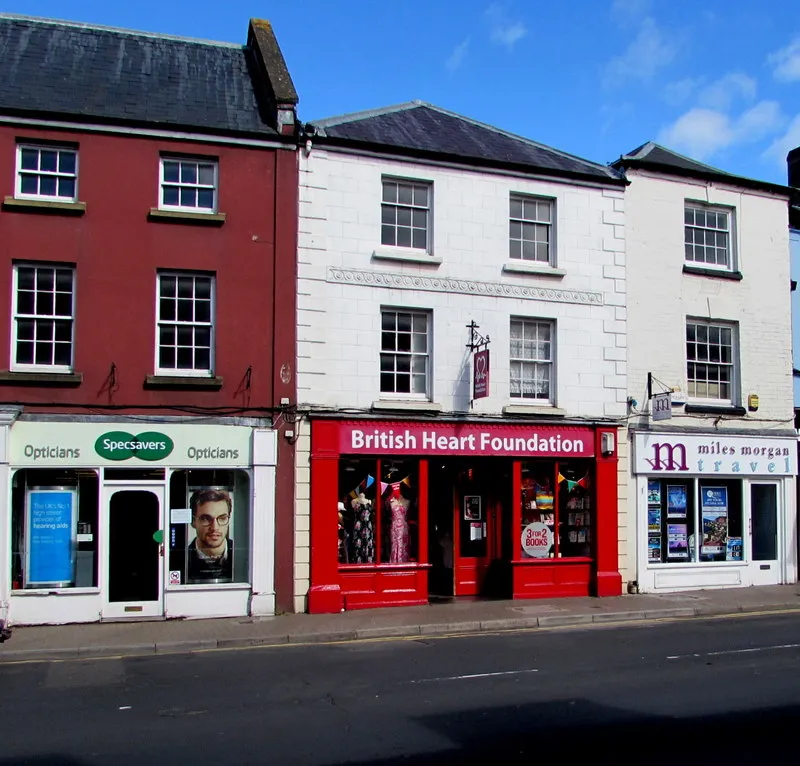
Photo: Jaggery , CC BY-SA 2.0, via Wikimedia Commons
On a damp Tuesday morning, the high street is doing its usual impression of a place that has forgotten what it is for. The bus shelter hums. A man in a fleece is eating a pasty with tremendous focus. And then there is the window.
It is not a shop window in the polished, corporate sense. There is no seasonal campaign, no QR code begging to be scanned, no mannequin dressed by a committee in a distant office. Instead, there is a ceramic duck in a top hat, a single roller skate, three paperback thrillers arranged like a fan and a handwritten card that says, simply, ‘Bric-a-brac – 50p and up’. It is, by some distance, the most honest entertainment on the street.
The Curator’s Chair
Charity shop windows are not really ‘designed’. They are assembled, often by a volunteer who has been in the back room since 8.30am, has already sorted four bags of donations and has roughly twenty minutes to make the front of the shop look like somebody cares. The result is a kind of accidental collage: a wedding dress next to a packet of fairy lights, a jigsaw of the Cotswolds propped against a fondue set, a pair of bowling shoes placed with the toes pointing towards the door as if they are considering leaving.
The people who arrange these windows are the unpaid dramaturgs of the high street. They have no budget, no training and no desire to be called ‘visual merchandisers’. They work by instinct. If something is yellow, it goes with the other yellow thing. If something is tall, it goes at the back. If something is inexplicable, it goes in the middle with a price tag that suggests confidence.
One volunteer I spoke to described her method as ‘trial and error, but mostly error’. Another said, ‘We don’t do minimalism. We do what we’ve got.’ That should be printed on a tea towel and sold for £3.50.
The Donation Lottery
The real plot twists arrive in bin bags. A charity shop window is a weekly episode of a show nobody wrote, and the cast changes without warning. On Monday it is a display of sensible cardigans. By Thursday it is a tribute to brass ornaments, a lone walking stick and a boxed set of VHS tapes labelled ‘Fishing with Fred’. Nobody knows where Fred came from. Nobody asks.
There is a particular category of donation that volunteers call ‘the conversation piece’. This is the object that cannot be identified but is clearly too substantial to bin. A brass thing that might be a doorstop, a paperweight or a small urn. A wooden bowl with a handle. A kitchen gadget last manufactured during the Wilson government. These items are priced at £1.50, placed near the front and left to do their work.
And they do work. A window is not a static display; it is a slow conversation with the street. People stop, frown, point. Children ask questions that adults cannot answer. A single roller skate becomes a talking point. A commemorative plate for a royal wedding nobody remembers becomes a small local mystery. The window does not need to be good. It needs to be interesting.
Price Tags and Tiny Feuds
Behind every window is a pricing debate, and behind every pricing debate is a volunteer with strong feelings about a marker pen. The £1.50 tag is the sweet spot: low enough to be an impulse, high enough to feel like the shop is not giving away the family silver. But getting there is not always peaceful.
One school of thought says price it low and move it on. The other says that a 1990s mug is technically ‘retro’ and should be £3. There are disagreements about whether a mass-produced ornament is ‘vintage’ or simply ‘old’. There are discussions about whether a jigsaw with three missing pieces should be 50p or free. These are not bitter rows, exactly. They are more like weather systems moving through a back room, expressed through the repositioning of a lamp.
The window is where those debates become visible. A carefully placed ‘sale’ sign can be a peace offering. A sudden cluster of 50p stickers can be a silent policy shift. Regular customers learn to read the signs. They know that if the good stuff has been moved to the back, a new delivery is due. They know that a handwritten ‘rare’ label means somebody has taken a punt.
High Street Rivalries
Charity shops do not exist in a vacuum. They exist down the road from other charity shops, and the window is where the rivalry gets quietly theatrical. There is the hospice shop with its immaculate colour coordination. There is the animal rescue shop with its cheerful chaos. There is the one that always seems to have a wedding dress, like a recurring character who refuses to be written out.
The unspoken rule is simple: do not put your best stock out when the rival has had a delivery. Do not let the other window get the good lamp. And if somebody has managed to create a full beach scene in October using only a deckchair, a straw hat and a copy of a Dan Brown novel, you had better believe the neighbouring shop will respond with a ‘back to school’ display featuring a single satchel and a laminated sign about pencil cases.
Regulars do a circuit. They walk from one window to the next, comparing prices, scanning for oddities, treating the whole street like a gallery with very reasonable admission. The charity shop window is the high street’s social feed: a noticeboard for lost cats, choir practice and odd donations, all framed by a pane of glass that could do with a wipe.
The £1.50 Legend
Every so often, an object becomes a local celebrity. A ceramic duck in a top hat. A teapot shaped like athatched cottage. A framed photograph of a dog in a bow tie. It sits in the window for weeks, priced at £1.50, and nobody buys it. The staff grow fond of it. A name is agreed. A child waves at it on the way to school.
Then one day, somebody buys it. The window feels strangely empty. The next week, a replacement appears – not the same, but close enough to keep the story going. This is the quiet magic of the charity shop window. It is not curated for algorithms. It is not optimised for conversion. It is a small, human, slightly chaotic slice of the street, and it changes every week.
In 2026, when so much of the high street is polished and predictable, that feels oddly valuable. The window asks nothing of you. It does not want a subscription or a review. It just wants you to look. And if you see a brass thing that might be a doorstop, a paperweight or something slightly more mysterious, it is £1.50. Probably.