Stuffed, Stitched and Slightly Spiteful: The Village Scarecrow Trail Is Not a Gentle Pastime
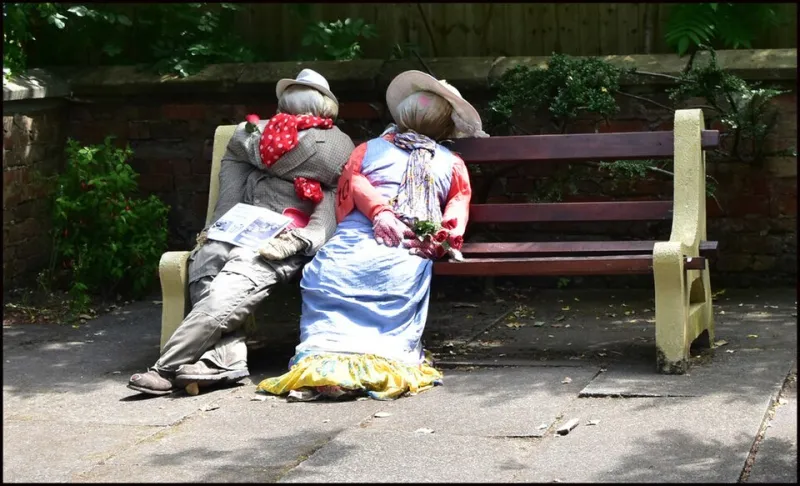
Photo: Norman Caesar, CC BY-SA 2.0, via Wikimedia Commons
On a damp Saturday in late spring, a village high street turns into an open-air gallery of the slightly unhinged. A scarecrow in a floral pinny is pegged to a gatepost. Another, dressed as a 1980s pop star, appears to be climbing out of a wheelie bin. A third is simply a pair of tights, a straw hat and an expression of quiet menace. This is the British scarecrow trail, and it is not as gentle as it looks.
Across the UK, villages from Lancashire to the Yorkshire Dales, from Cheshire to Norfolk, have turned the humble straw effigy into a seasonal event. You buy a map from the village hall for a couple of pounds, follow numbered clues, and spend an afternoon spotting increasingly elaborate figures in gardens, porches and pub car parks. In 2026, with the cost of a family day out doing its usual gymnastics, the appeal is obvious. It is cheap, it is local, and it gives everyone something to talk about that is not the potholes.
A Straw Effigy With a Grudge
Wray in Lancashire and Kettlewell in the Dales are perhaps the best-known examples, but the format has spread to dozens of smaller places. The basic idea is simple: residents make a scarecrow, stick it outside, and hope the trail map brings a few curious walkers past their front door. In practice, it is a low-stakes competition with high-stakes feelings.
A scarecrow is a strange thing to care about. It is, after all, a bundle of straw and old clothes. But once it has a name, a backstory and a prime position near the village green, it becomes a local character. Children adopt favourites. Adults pretend not to have favourites. Someone always says, ‘It’s just a bit of fun,’ in a tone that suggests it is not just a bit of fun at all.
The unspoken contest is not always about the best-made figure. It is about wit, placement and the ability to make passing strangers smile without appearing to try too hard. A scarecrow that is too polished can feel like a show-off. One that is too slapdash can feel like a insult to the trail. The sweet spot is a figure that looks as if it was assembled in a shed on a Thursday evening and accidentally became the talk of the parish.
The Theme Is Everything (Until It Isn’t)
Many trails have a theme. This year it might be films, or heroes, or ‘the seaside’. The theme is announced months in advance and then interpreted with the loose creativity of a school art project. One household will follow it precisely. Another will ignore it entirely and dress a scarecrow as a local bus driver who retired in 2019. Both will be judged.
The best entries tend to be the ones that work on two levels. A scarecrow outside a bakery dressed as a famous television judge is funny. A scarecrow outside a bakery dressed as a famous television judge, holding a slightly burnt loaf and a card reading ‘soggy bottom, no star’, is funnier. The trail rewards people who know their audience, and their audience is everyone who walks past.
Materials are a recurring issue. Straw is traditional, but old tights, bubble wrap, footballs, plastic piping and charity-shop suits all make an appearance. There is a quiet economy in used clothing. A scarecrow wearing a genuinely nice coat will prompt comment. A scarecrow wearing a wedding dress will prompt a parish council memo. The general rule is that anything that might blow away, frighten a dog or be mistaken for a real person after dusk should be tied down with more zip ties than seems reasonable.
Rules of the Trail, Written and Otherwise
There are official rules, usually printed in small type on the back of the map. Don’t block pavements. Don’t use offensive imagery. Don’t put scarecrows where they might distract drivers. Take your litter home. These are sensible and largely followed.
Then there are the unwritten rules. Don’t outshine a neighbour’s memorial scarecrow. Don’t pinch a child’s entry idea from last year. Don’t leave your figure up so long that it becomes a soggy, sad reminder of a summer that never quite arrived. And whatever you do, don’t win the rosette three years running without expecting a certain cooling of tea-room conversation.
The judging is where the tension lives. Categories often include best in show, best children’s entry, most humorous and best use of recycled materials. Judges might be the vicar, a retired teacher, a local business owner and someone’s aunt who once appeared on a quiz show. They walk the trail with clipboards, confer in low voices and occasionally laugh in a way that makes nearby exhibitors nervous. The rosette is small. The bragging rights are not.
Sabotage, Stitching and the Judging Tent
Outright sabotage is rare, but ‘adjustments’ are not unknown. A hat goes missing. A sign is turned around. A scarecrow that was facing the road is found facing a hedge. Nothing is ever proved. Everyone has a theory. The phrase ‘I’m sure it was the wind’ has done a lot of heavy lifting in village life.
Most of the effort, though, goes into the making. Families gather around kitchen tables with glue guns and straw. Someone’s grandad is drafted in to build a frame. A teenager is persuaded to donate an old hoodie. The result is part craft project, part family argument, part community theatre. On the day, the scarecrow goes out into the world and is immediately judged by strangers with a map.
And that, really, is the charm of it. The scarecrow trail is a gentle sort of anarchy. It asks people to make something silly in public, to follow a route they would never otherwise walk, and to accept that their best effort might be beaten by a figure made from a mop and a pair of novelty sunglasses. It raises a few quid for the church roof or the village hall, gives children something to count, and provides weeks of material for the parish newsletter.
In 2026, when so much of our entertainment arrives through a screen and a subscription, there is something quietly radical about a day out that depends on a photocopied map and a willingness to walk past strangers’ front gardens. The scarecrows are ridiculous. The feuds are tiny. The whole thing is oddly gripping. And somewhere, on a street you have never visited, a straw figure in a borrowed cardigan is currently winning an argument without saying a word.